

Weekday morning and evening editions. Saturdays once. Good news on Sundays. All sources labeled.
THE DINNER AND THE DISTANCE
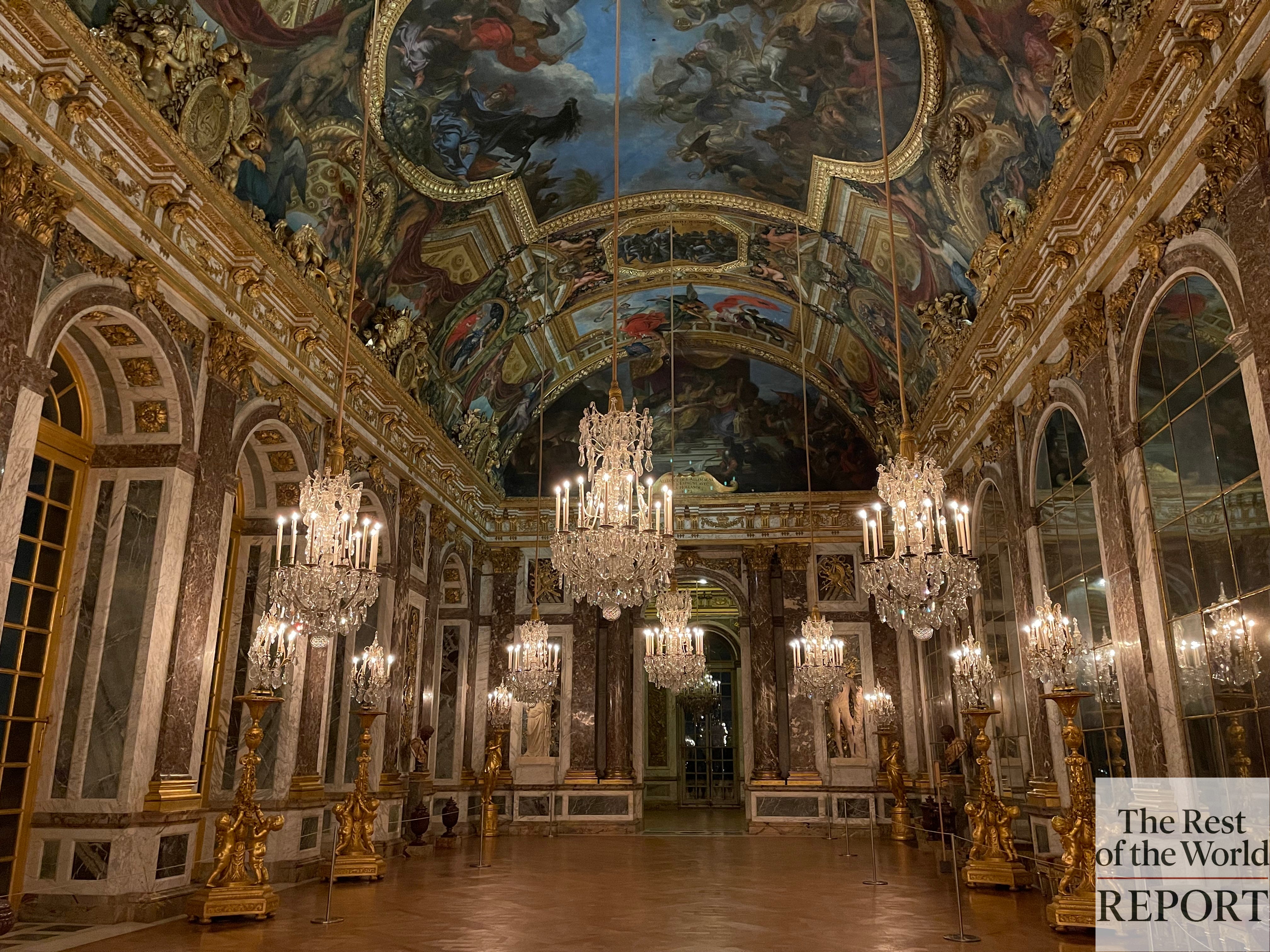
Tonight, Emmanuel Macron hosts Donald Trump at the Palace of Versailles. The Hall of Mirrors. The Grandes Eaux nocturnes. Fireworks over the gardens of the Sun King. The palace is closed to the public all day. Road closures and a security perimeter are disrupting the entire city center. Macron moved the G7’s start date to accommodate Trump’s 80th birthday celebrations. He planned this summit around his guest. He is ending it with the most extravagant stage France has to offer.
The dinner is not reconciliation. It is maintenance. A French lawmaker from Macron’s own party described the whole G7 as something European leaders “just need to get through,” adding: “We need to avoid a situation like in Canada last year, when Trump left [the G7] early, or a crisis over Greenland.” No communiqué was attempted this year. The bar was set at: Trump stays for all three days.
He stayed. He called the venue “the real deal.” He pushed back on European allies for their failure to support the US during the Iran war. He threatened French wine with tariffs. Macron pushed back on that from national television: “It’s not the US that decides European or French law — that’s normal and it won’t be any different, at least as long as I am around.” On Ukraine, European leaders came hoping to secure harder sanctions on Russia and air defense commitments; they did not get them. On Iran, Trump told G7 partners the deal was entering a “second phase” and the US would not fund Iran. Britain and France signaled interest in assisting with Hormuz demining once hostilities formally pause. The summit produced no major agreements on anything else.
Victor Cha, head of geopolitics and foreign policy at the Center for Strategic and International Studies in Washington, told Reuters what the week looked like from the outside: “What we are increasingly seeing is Europeans beginning to think about a life with less America.”
That sentence deserves to sit for a moment. It was said not by a European politician, not by a foreign adversary, but by one of Washington’s most establishment foreign policy voices, a man who served on the National Security Council, who holds the Korea Chair at CSIS, who speaks the language of the alliance. And he said it to Reuters, for the record, this week, while the leaders of the Western world gathered in France to maintain the appearance of unity.
The dinner at Versailles is the appearance. The construction of European strategic autonomy — real military, industrial, and economic independence from the United States — is the reality being built in parallel. The choice of setting is not incidental. France’s military support helped America win its independence from Britain. On September 3, 1783, the day America’s Treaty of Paris was signed, France signed its own peace with Britain at Versailles — in the same palace where tonight’s dinner will be held. Tonight Macron hosts the leader of that country, 243 years later, while his continent quietly considers what independence from America might look like.
🇺🇸 What American readers need to know: The G7 ended without a communiqué, without major agreements, and with Trump pushing back on allies who declined to support a war that has now cost the region more than 7,300 lives. Macron is throwing the most lavish dinner France can produce tonight. A senior Washington foreign policy voice told Reuters this week that Europeans are beginning to imagine life without American leadership. Both things are true simultaneously.
Sources: France 24 (France, public broadcaster — Versailles closure, AI day agenda, Iran second phase, no gala framing, June 17 0337 GMT); Digital Journal/AFP (AFP wire — Trump “real deal” quote, Panot criticism, end-of-term Macron context); Denver Gazette (US — “just need to get through” quote, Trump “COWARDS” post, 2025 Canada comparison); NBC News (US — mutual suspicion, Ned Price analysis, Canada 51st state context); Al Jazeera (Qatar, state-funded/editorially independent — Victor Cha Reuters quote confirmed); Bloomberg (US — Macron wine tariff rebuttal verbatim); Sortiraparis (France — Versailles closed all day, road closures, 1783 Peace Treaty context, June 17)
NO ARREST, NO NAME, NO ANSWERS
On Tuesday night, the city of Senatobia confirmed that the officer who shot and killed one-year-old Kohen Wiley in a Walmart parking lot on Sunday has been placed on administrative leave. The action was taken by the mayor and Board of Aldermen at their Tuesday meeting. The officer has not been publicly identified. No arrest has been made. The Mississippi Bureau of Investigation, which is leading the inquiry, has not announced a timeline for its findings.
Three developments since Tuesday night’s edition mark where this story stands:
Civil rights attorney Ben Crump and Attorney Van Turner have been retained by the family. Crump’s statement: “A 1-year-old child is dead because police officers in Mississippi opened fire on a car in a crowded Walmart parking lot. Kohen Wiley was a baby. His mother, who has not been charged with any crime, says she was trying to communicate to officers that there was a baby in the car. They fired anyway, leading to the death of an innocent 1-year-old. We intend to seek justice for baby Kohen and the life that was stolen from him.”
After a community rally at Senatobia City Hall on Tuesday afternoon, Tate County sheriff’s deputies deployed tear gas on protesters who had moved to the Walmart parking lot where Kohen was killed. Law enforcement remained at the Walmart for hours afterward. Community member Aretha Lester, speaking before the tear gas was deployed: “Today it’s in their community, tomorrow it’s in mine, tomorrow it might be on my doorstep. I have a child. I have grandchildren too.”
The Mississippi Department of Public Safety’s own statement contains a detail that has received insufficient attention: it acknowledges that officers saw the child before the vehicle moved and before the officer fired. The official justification for the shooting is that the driver moved the car toward officers. The officer fired anyway, into a car the department’s own statement confirms contained a known child.
🇺🇸 What American readers need to know: The officer who shot and killed a one-year-old is on administrative leave, not arrested. No name has been released. Protesters who gathered to demand answers were met with tear gas. The family has retained Ben Crump. The MBI investigation is active. Watch for whether the Justice Department opens a parallel civil rights investigation.
Sources: WREG Memphis (US local TV — administrative leave confirmed, city statement Tuesday night, tear gas, law enforcement hours at Walmart); Mississippi Today (US — Crump statement, MBI investigation, Lester quote); Ben Crump Law (US — Crump full statement, Van Turner retention confirmed, June 16); Mississippi Free Press (US — DPS statement child visibility acknowledgment, bullet hole correction, updated June 17); Newsweek (US — officer not officially identified, administrative leave standard protocol confirmation)
FIFTY YEARS, TWO VERDICTS
On June 16, 1976, thousands of Black school students marched through Soweto to protest the apartheid government’s imposition of Afrikaans as the language of instruction in their schools. Police opened fire. At least 176 students were killed in the days that followed. Many were children. The photograph of 13-year-old Hector Pieterson being carried after being shot, taken by Sam Nzima, became the image that showed the world what apartheid looked like. The uprising did not end apartheid immediately. It changed the trajectory of the liberation movement. Nelson Mandela was released 14 years later. South Africa held its first all-race elections 18 years after Soweto.
Yesterday was the 50th anniversary. South Africa marked it with national commemorations. In Paris, South Africa’s Permanent Delegation to UNESCO held a documentary screening and panel discussion marking the anniversary — the same week, in the same country, that South Africa was excluded from the G7 at US insistence. President Cyril Ramaphosa addressed the nation’s youth: “Exactly 50 years later, as young South Africans, you face a different challenge: finding your place in an economy that has for too long kept its doors closed.”
The rest of Africa heard that address in a complicated register. On June 11, South Africa opened the World Cup against Mexico in Mexico City and lost 2-0. Across the continent, African fans cheered for Mexico. Nigerian fans wore El Tri kits outside the stadium. Ghanaians, Zimbabweans, Mozambicans, and fans from across sub-Saharan Africa rooted actively against Bafana Bafana on social media and in stadiums. Not as a football preference. As a verdict.
The verdict was about what has been happening inside South Africa’s borders. In May 2026, anti-migrant violence erupted in the Western Cape. Anti-migrant groups set a June 30 deadline for all undocumented foreigners to leave. Two Mozambicans were killed in Mossel Bay. Foreign-owned businesses were looted in the Western Cape. Hundreds of Congolese, Rwandan, and Somali nationals sought refuge in temporary camps in KwaZulu-Natal as locals went door-to-door ordering them out. Ghana evacuated roughly 1,000 citizens. Mozambique repatriated 700 after five nationals were killed. Zimbabwe evacuated 139. Nigeria began repatriating more than 1,000. The South African government’s own statistics show the country’s undocumented migrant population has grown from 7.8 million to higher levels since late 2025.
Veteran Ghanaian journalist Kwesi Pratt Jnr framed it on Ghana’s Metro TV in May: “The problem of xenophobia is a continuation of the apartheid system of governance.” That framing is the one circulating across the continent. The charge is not that South Africa has economic problems. The charge is that it is using the same logic the apartheid state used — scapegoating a population for structural inequality, enforcing exclusion through violence — against its African neighbors.
The continent that helped liberate South Africa is now asking whether South Africa has extended that liberation inward. The 50th anniversary of Soweto arrived at exactly the moment when the answer to that question, across much of Africa, is no.
South Africa was also excluded from the G7 this week, at the insistence of the United States, despite the summit’s stated focus on global inequality and critical minerals, sectors in which South Africa is a world-significant player.
🇺🇸 What American readers need to know: Yesterday South Africa marked 50 years since children were shot in its streets for demanding the right to learn in their own language. This week the G7, hosted in France, excluded South Africa at US insistence. That same South Africa is being judged by its own continent for how it treats African migrants today. History does not move in straight lines. June 16, 2026 had three layers, and American media covered none of them.
Sources: Al Jazeera (Qatar, state-funded/editorially independent — 50th anniversary retrospective, Ramaphosa quote, AP images confirmed, anti-migrant crisis context, multiple evacuations confirmed); Jamaica Observer (Jamaica — Nigerian fans in El Tri kits, Mexico 2-0 result, two Mozambicans killed, evacuation figures); Modern Ghana / USA Herald (Ghana — Kwesi Pratt Jnr Metro TV quote confirmed, evacuation scale, Gamfoot Transfers video); Business & Financial Times Ghana (Ghana — Western Cape violence timeline, June 30 deadline, KwaZulu-Natal camp detail, Congolese/Rwandan/Somali nationals); GBC Ghana Online (Ghana — pan-African backlash framing, X user quotes, Mexico opener reaction); SAnews (South Africa, government news service — ministerial statements, Youth Day programming, Manamela education quote)
WAR DAY 110 | NUMBERS AT PUBLICATION
🇮🇷 Iran: 3,468 killed, 26,500+ injured (Iran Ministry of Health, via Al Jazeera live tracker, last updated June 10)
🇱🇧 Lebanon: 3,696 killed, 11,413 injured (Al Jazeera live tracker, last updated June 10)
🇮🇱 Israel: 26 killed, 7,791 injured (Al Jazeera live tracker, last updated June 10)
🌍 Gulf states/Iraq: 131 killed — Iraq 118, Kuwait 7, Bahrain 3, Oman 3 (Al Jazeera live tracker, last updated June 10)
🇺🇸 US military: 13 killed, 381 injured (Al Jazeera live tracker, last updated June 10)
🛢️ Brent crude: $79.16/barrel (OilPrice.com — continuing to fall; down $17 from the May 25 peak of $96.14)
⛽ US national gas average: $4.03/gallon (AAA)
Sourcing note: All war casualty figures sourced to the Al Jazeera live tracker, last updated June 10, 2026. Iran figure sourced to Iran’s Ministry of Health. Figures should be treated as floor estimates; strikes have continued since June 10. Methodology differs between sources; figures are not directly comparable.
“Whenever the people are well informed, they can be trusted with their own government.” — Thomas Jefferson, 1789


