
The Rest of the World Report | May 13, 2026 — Evening Edition
The View From Everywhere Else

Weekday morning and evening editions. Saturdays once. Good news on Sundays. All sources labeled.
I will never put the news behind a paywall. If you want to support keeping it free for everyone else, there’s a paid option. That’s all it is.
THE PRESIDENT, THE VICE PRESIDENT, AND THE NAME THAT HAD TO CHANGE
Air Force One touched down at Beijing Capital International Airport at 7:50 p.m. local time Wednesday — 7:50 a.m. EST. Three hundred children in blue and white uniforms waved American and Chinese flags on the tarmac. A brass band played. The red carpet was literal. Donald Trump descended the steps, offered a fist pump, and was greeted not by Xi Jinping but by Chinese Vice President Han Zheng.
That protocol choice is worth noting without overstating. Xi did not personally greet Obama at the airport either. In Chinese diplomatic choreography, dispatching the vice president to lead an airport welcome is a high-level gesture — Han is a retired member of the Politburo Standing Committee, the party’s top decision-making body, and is widely regarded as Xi’s envoy for exactly these moments. CNN noted it as “a sign of the importance of the trip.” What it is not is the extraordinary “state visit plus” treatment of 2017, when Xi met Trump personally and opened the Forbidden City for a private dinner. China is signaling respect, not warmth. The distinction is deliberate.
The delegation Trump brought with him tells a story of its own. Traveling with the president: Elon Musk of Tesla and SpaceX. Tim Cook of Apple, in what is expected to be his final major diplomatic trip as CEO before his September retirement. Jensen Huang of Nvidia, who was not on the original passenger list and joined the delegation at the Alaska refueling stop, his late addition noted by reporters given his years of effort to persuade the administration to relax restrictions on Chinese purchases of Nvidia’s advanced AI chips. Kelly Ortberg of Boeing, negotiating a major aircraft sale. Larry Fink of BlackRock, David Solomon of Goldman Sachs, Jane Fraser of Citigroup. More than a dozen CEOs in total. Eric Trump and Lara Trump traveled in a personal capacity. The Washington Post noted that Trump told reporters he was going to advocate for his corporate delegation so that “these brilliant people can work their magic.” The summit’s stated agenda is Iran and trade. The actual agenda is visible on the passenger manifest.
One detail from the delegation has received almost no American coverage and deserves it. Secretary of State Marco Rubio has been under Chinese sanctions since 2020, imposed in response to his public criticism of China’s human rights record in Xinjiang and Hong Kong. Those sanctions normally bar entry to China. NBC News reported that in order to make Rubio’s attendance legally possible, China changed the Chinese character transliteration of his name after he was named Secretary of State, using a different character for one syllable, creating a technically different person under Chinese law. The Secretary of State of the United States entered Beijing because China rewrote his name. That is either a remarkable diplomatic accommodation or a remarkable demonstration of the limits of Chinese sanctions as a serious instrument. Possibly both.
The bilateral meetings with Xi begin Thursday morning Beijing time — tonight EST. The stated US agenda is Iran and trade. On Monday, Trump confirmed that the $11 billion Taiwan arms sale was on the agenda. On the flight to Beijing Wednesday, he said something different: “I don’t know that we’ll even speak about Taiwan. I’m not sure. He may want to ask about it. There’s not that much to ask about. Taiwan is Taiwan.” Whether that represents strategic ambiguity, pre-negotiation positioning, or simply Trump speaking before thinking, no one outside the room can say with confidence. What is certain is that Taiwan’s government is watching the official wording that emerges from tomorrow’s meetings with extreme care — any shift from “does not support” to “opposes” Taiwanese independence would represent the most significant US movement on Taiwan since Carter broke formal relations in 1979.
While Trump was landing in Beijing, the BRICS Foreign Ministers’ Meeting was opening in New Delhi — Thursday morning local time, tonight EST. Iran’s Araghchi, Russia’s Lavrov, India’s Jaishankar, and foreign ministers from across the Global South are gathering at Bharat Mandapam for two days of sessions chaired by India under its BRICS 2026 theme: “Building for Resilience, Innovation, Cooperation and Sustainability.” Malaysia’s foreign minister told reporters Wednesday that his country’s participation reflects a push for “a more inclusive, stable and sustainable global system,” and an aspiration to become a full BRICS member, a signal of the bloc’s growing appeal even as it struggles to find consensus on the war that involves two of its own members.
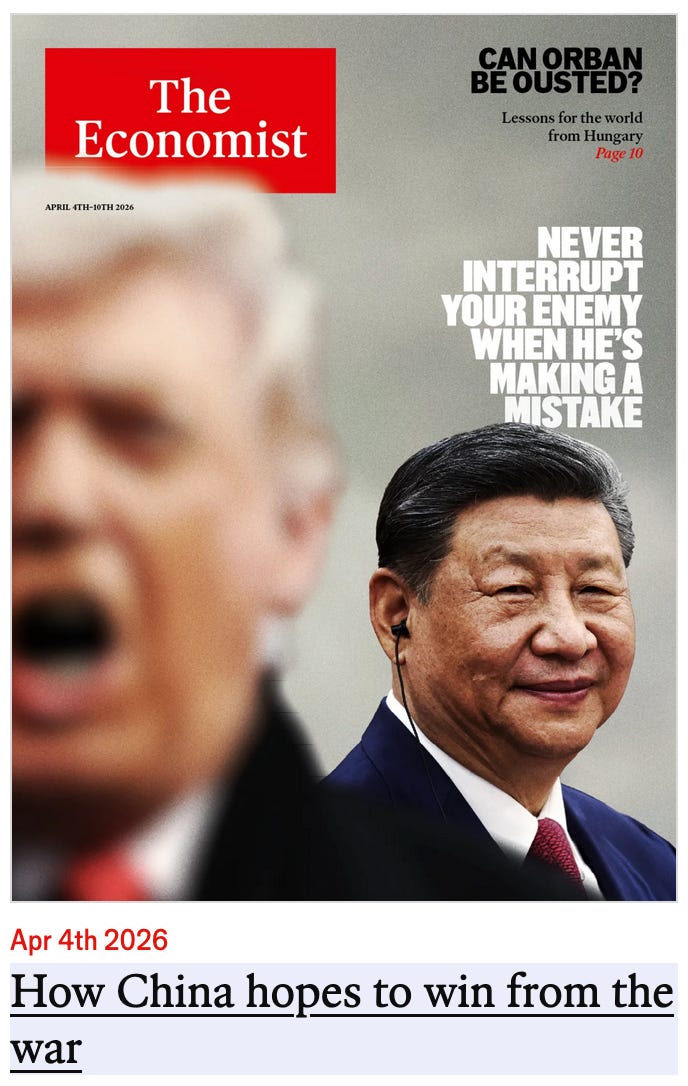
The international press is covering these two meetings very differently from the American press. Al Jazeera’s analysis is blunt: Trump arrives in Beijing “desperate for a win,” with China holding the upper hand. Wei Liang, professor at the Middlebury Institute of International Studies at Monterey, told Al Jazeera: “Right now is the best time for Xi to have this negotiation as the US is busy with wars, and domestically, Trump’s rating is low, and he needs a win.” The Economist’s April 4 cover — featuring a photograph of Xi looking at Trump alongside a quote attributed to Napoleon Bonaparte, “Never interrupt your enemy when he is making a mistake” — has circulated widely in international media as a summary of Beijing’s strategic posture. Inderjeet Parmar, professor of international politics at City St George’s, University of London, told Al Jazeera that Trump arrives “chastened” by the shortcomings of the Iran war: “He needs Chinese support for opening the Strait of Hormuz. China needs the Strait of Hormuz to open for its own reasons. At the same time, they can use this as leverage regarding Taiwan.” From Beijing itself, Feng Chucheng of Hutong Research told Al Jazeera that China’s primary goal is predictability: “Beijing needs to be able to plan its own economic policies” through January 2029. Wang Wen, dean of the school for global leadership at Renmin University, said China hopes the meeting returns the relationship to “peaceful coexistence, mutual respect, and win-win cooperation.” European coverage is focused on a different fear entirely: that a US-China “G2” deal cuts Europe out of decisions on trade, technology, AI governance, and climate finance. “Europe’s anxiety is not only about rivalry; it is also about exclusion,” Jing Gu of the IDS told Al Jazeera. In New Delhi, the BRICS coverage in Indian and regional media is not framed as a sideshow to Beijing. It is framed as the alternative architecture, the framework that operates regardless of what Trump and Xi announce.
🌍 TRANSLATOR’S NOTE: The gap between how American media is covering this week and how the rest of the world is covering it is itself the story. Al Jazeera’s analysts, drawing on academics from Tsinghua University in Beijing, Renmin University, City St George’s London, the IDS in the UK, and the International Crisis Group, are framing this summit not as an opportunity for American leadership but as a moment of American vulnerability. The Economist’s Napoleon cover has become the international shorthand for Beijing’s posture. European outlets are focused not on Iran or Taiwan but on the G2 fear: that Washington and Beijing cut a deal that excludes Europe from the rules of trade, technology, and AI governance. The Global South press, particularly in India, is covering BRICS in New Delhi as an equally significant event, not a footnote to Beijing. The world is not waiting for Trump and Xi to announce a solution. It is building structures that function regardless of what they announce.
🇺🇸 WHAT AMERICAN READERS NEED TO KNOW: The summit begins tonight. The delegation Trump brought is a corporate wish list as much as a diplomatic mission. The Secretary of State entered China under a renamed identity because China rewrote his name to get around its own sanctions. Trump said on Monday the Taiwan arms sale was on the table. He said on the plane it might not even come up. Both statements came from the same president in the same week. The meetings produce results Thursday and Friday. What is announced publicly will be carefully worded. What matters will be in the details, and in what the Taiwan government says about the outcome after the cameras are off.
Sources: CNN (US — arrival details, Han Zheng protocol, children ceremony, confirmed this session); CNBC (markets and business — CEO delegation, Jensen Huang late addition, summit schedule, confirmed this session); Washington Post / AP (wire — Trump “brilliant people” quote, Eric/Lara Trump, confirmed this session); NBC News live blog (US — Rubio name transliteration detail, Huang Alaska boarding, confirmed this session); Euronews (European, broadly centrist — Tim Cook retirement context, Boeing/bank CEOs, confirmed this session); Iran Front Page / AFP (wire — Trump Taiwan “not that much to ask about” quote, confirmed this session); Al Jazeera (Qatar, state-funded/editorially independent — Wei Liang quote, China upper hand analysis, Napoleon/Economist cover, confirmed this session); Al Jazeera (Qatar, state-funded/editorially independent — Parmar quote, Heurlin analysis, Feng Chucheng Hutong Research quote, Wang Wen Renmin University quote, confirmed this session); Al Jazeera (Qatar, state-funded/editorially independent — G2 Europe exclusion fear, Gu IDS quote, Global South framing, confirmed this session); Daily Pioneer / ANI (India — BRICS New Delhi opening, Jaishankar chairing, confirmed this session); The Star / Bernama (Malaysia — Malaysia FM statement, BRICS membership aspiration, confirmed this session)
CHILDREN ON THE HIGHWAY
The Lebanese delegation arrives in Washington carrying something that was not in the State Department’s briefing book. On Wednesday, the day before US-mediated peace talks between Lebanon and Israel were scheduled to begin, Israeli drones struck three vehicles on the main coastal highway linking Beirut to southern Lebanon. At least 12 people were killed, including a woman and her two children, according to Lebanon’s Ministry of Health. The strikes hit in the Jiyeh area, roughly 20 kilometers south of the capital. Photographs shared by Lebanon’s National News Agency showed cars charred and torn apart on the road. First responders extinguished flames from the vehicles.
This was not an isolated incident in an otherwise quiet day. Tuesday saw 13 people killed by Israeli strikes, including two Lebanese Civil Defence paramedics, Hussein Jaber and Ahmad Noura, killed in a drone strike on their vehicle. On May 10, 51 people were killed in Israeli strikes in a single day. Israel has struck Lebanon every day since the April 16 “ceasefire” took effect. The cumulative toll since Israel renewed major operations on March 2 now exceeds 2,700 killed and 1.2 million displaced.
Israel’s stated justification for Wednesday’s highway strikes has not been publicly released at time of publication. The IDF has consistently said its operations target Hezbollah infrastructure, personnel, and supply routes. The Beirut-south highway is a major civilian artery. Al Jazeera’s Zeina Khodr, reporting from Tyre, said the conflict “is only escalating” and described the toll on civilians who remain in the area, with only three functioning hospitals left in the entire Tyre district. She noted that people wounded in strikes are dying not from their injuries but from the length of the journey to reach medical care.
The Lebanon-Israel talks in Washington begin tomorrow with an agenda the State Department has described as “intensive”: a comprehensive peace and security agreement, full Lebanese sovereignty, Hezbollah’s disarmament, and border delineation. Secretary Rubio said this week that “peace is possible.” Lebanese President Aoun has said the timing is not yet right for a direct meeting with Netanyahu. The Lebanese delegation, led by Simon Karam, arrives in Washington having watched Israel kill 12 of their countrymen on a public highway the morning before the talks began. The talks are at the delegation level. The war is at the civilian level.
🌍 TRANSLATOR’S NOTE: The timing of Wednesday’s strikes has been noted with particular sharpness in Arab media. Al Jazeera’s framing placed the highway killings explicitly in the context of tomorrow’s Washington talks, describing it as Israel striking Lebanon “a day before new US-mediated negotiations.” That framing is factual and the timing is documented. Whether the strikes were intended to signal something to the Lebanese delegation, to Hezbollah, or were simply an operational decision with no diplomatic calculation attached, is not something any public source can confirm. What can be confirmed is the sequence: 12 dead on the highway, including children. Talks begin in the morning.
🇺🇸 WHAT AMERICAN READERS NEED TO KNOW: The US is hosting peace talks between Lebanon and Israel starting tomorrow. Israel killed 12 people, including children, on a Lebanese highway today. The US has not publicly condemned the strikes. Secretary Rubio said peace is possible. The Lebanese government is sending its delegation to Washington regardless. What the United States says, or does not say, about today’s strikes before tomorrow’s talks begins will tell the Lebanese delegation, and the watching Arab world, something about what kind of mediator Washington intends to be.
Sources: Al Jazeera / AFP (wire — highway strikes, 12 killed, two children, Jiyeh location, Khodr reporting, confirmed this session); Washington Post / AP (wire — Health Ministry figures, woman and two children confirmed, confirmed this session); Al Jazeera video report (Qatar, state-funded/editorially independent — 12 total confirmed, pre-talks timing framing, confirmed this session)
THE CLOCK NOBODY IS STOPPING
The Senate voted again today. The result was the same as before. A War Powers Resolution introduced by Senator Jeff Merkley of Oregon failed to advance Wednesday, another in a sequence of failed votes that has now stretched across more than two months of unauthorized military action.
The war began February 28. Congress received formal notification March 2. The 60-day constitutional deadline under the War Powers Resolution of 1973 arrived May 1. The Trump administration’s argument — that the ceasefire pauses the clock — remains in force despite the president’s own description of that ceasefire as being on “massive life support.” The Senate has now rejected War Powers resolutions more than half a dozen times. Each vote has failed. The war continues.
What has shifted is the arithmetic on Republican defections. Senator Rand Paul of Kentucky, a longtime critic of expansive presidential war powers, has voted for every resolution since the war began. Two Republicans who had previously sided with their leadership changed their positions. Senator Susan Collins of Maine broke with her prior votes for the first time on April 30, on the eve of the 60-day deadline, saying further military action must have “a clear mission, achievable goals, and a defined strategy.” Today, Senator Lisa Murkowski of Alaska changed her vote for the first time, making Wednesday’s the closest yet at 49-50, one vote shy of advancing. “You’ve got a timeline that has taken us beyond the 60 days,” Murkowski told reporters. “I thought that perhaps we would get more clarity from the administration in terms of where we are, and I haven’t received it.” The war funding request — which congressional Republicans say privately will be “the real vote” — has not been submitted. Senate Majority Leader Thune has signaled he will not schedule an authorization vote anytime soon.
The administration has consistently argued, through Defense Secretary Hegseth, that the ceasefire pauses the 60-day constitutional requirement. It has also argued, through JD Vance’s pre-war statements, that the War Powers Resolution is “fundamentally a fake and unconstitutional law.” Courts have declined to rule on that question for decades, allowing every administration since Nixon to conduct military operations without congressional authorization. Trump is not the first president to use this space. He is using it at a scale and duration that is beginning to produce Republican discomfort that prior administrations did not face.
🌍 TRANSLATOR’S NOTE: The War Powers debate is being watched in European and international legal circles as a test of whether constitutional constraints on executive war-making in the United States retain any practical force. The pattern — Congress voting, the executive ignoring it, courts declining to intervene — is familiar. What is different here is the growing number of Republican senators who are not merely uncomfortable but publicly dissenting. Collins, Murkowski, Paul. The funding vote that hasn’t been called. The war plan that hasn’t been presented. The international read is not that Congress will stop this war. It is that the institutional resistance, however limited, is real and documented — and that what emerges from this conflict will shape the legal architecture of American executive war-making for years.
🇺🇸 WHAT AMERICAN READERS NEED TO KNOW: The war has been running for 74 days without congressional authorization. The Senate voted again today to invoke War Powers. It failed by one vote — the closest yet. Three Republicans are now on record against their party’s position. The ceasefire the administration is using to pause the constitutional clock is the same ceasefire the president calls “massive life support.” The war funding request has not arrived. Watch for whether the one-vote margin produces any additional Republican movement in the days ahead.
Sources: ABC News live blog / AP (wire — Merkley resolution, today’s failed vote, confirmed this session); CNN Politics (US — Hegseth clock argument, Murkowski deadline, Thune on authorization, confirmed this session); Time (US — Collins first vote, April 30 result, Collins quote, confirmed this session)
NUMBERS AT PUBLICATION
🇮🇷 Iran: 3,636+ killed (HRANA floor estimate — FROZEN since April 7; no updated HRANA report this session; Iranian Health Ministry figure as of May 5: 3,468 — methodology differs)
🇱🇧 Lebanon: 2,700+ killed and rising (Lebanese Ministry of Public Health — 12 killed on highway today alone; figure updating daily)
🇮🇶 Iraq: At least 118 killed (Iraqi health authorities — mostly PMF members)
🇮🇱 Israel: At least 26 killed, 7,791 wounded (Al Jazeera live tracker, as of May 5)
🌍 Gulf states: At least 28 killed (Al Jazeera live tracker — figure stable, no update this session)
🇺🇸 US military: 14 KIA confirmed (GlobalSecurity.org, May 7)
🛢️ Brent crude: $105.80/barrel (OilPrice.com, editor-confirmed)
⛽ US gas: $4.51/gallon national average (AAA, editor-confirmed)
Sourcing note: Iran casualties sourced to HRANA (US-based Human Rights Activists News Agency), a floor estimate. Iranian Health Ministry figure cited separately. Methodology differs; figures should not be treated as directly comparable.
WATCH LIST
🔴 Trump-Xi bilateral meetings, Thursday-Friday Beijing time. The real summit begins tonight EST. Taiwan language, arms sales, Iran framework, trade deal announcements — all in play. Watch for what the Taiwan government says after the meetings conclude, not what the joint communiqué says.
🔴 BRICS New Delhi, Thursday-Friday. Araghchi, Lavrov, Jaishankar in the same room. Iran’s multilateral guarantorship architecture being built simultaneously with Beijing. Watch for any joint statement language on Hormuz or a framework for an eventual Iran agreement.
🔴 Lebanon-Israel Washington talks open Thursday. The day after Israel killed 12 people on a Lebanese highway. Watch for whether the US addresses today’s strikes before the talks begin — and whether the Lebanese delegation signals any change in its position as a result.
🟡 Murkowski’s deadline — Friday. The Alaska Republican gives the White House until Friday to present a credible war plan. Watch for whether she introduces her authorization measure and whether any Republicans join her.
🟡 Kevin Warsh, Fed Chair. Confirmed by the Senate today. Markets will be watching his first public statements for signals on interest rate direction given Trump’s longstanding pressure for cuts.
“Whenever the people are well informed, they can be trusted with their own government.” — Thomas Jefferson, 1789