


Weekday morning and evening editions. Saturdays once. Good news on Sundays. All sources labeled.
Good morning. It’s Sunday. Here is what is going right.
I will never put the news behind a paywall. If you want to support keeping it free for everyone else, there’s a paid option. That’s all it is.
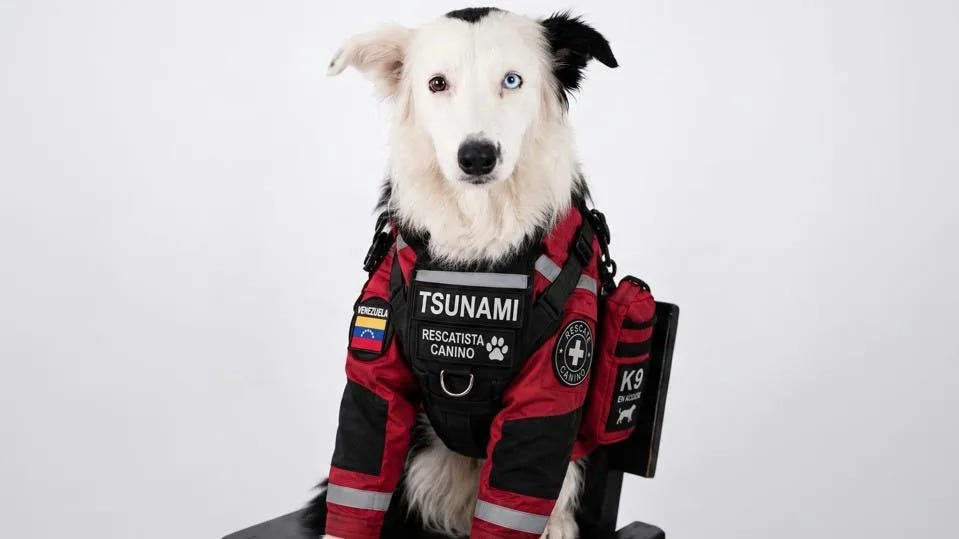
TSUNAMI
He was found on the streets of Caracas in 2017 — a puppy, malnourished, abandoned. A rescue organization called the Asociación Pro Defensa de los Animales took him in, restored his health, and found him a home. The home was Jorge Beens, founder of Venezuela’s K-SAR ECID disaster canine unit, who recognized in the young border collie something useful: an extraordinary nose and the drive to use it.
They spent years training. The specialty: finding human life inside collapsed structures.
On June 24, 2026, two earthquakes struck northern Venezuela thirty-nine seconds apart — magnitude 7.2 and 7.5. The second was the strongest Venezuela had experienced in more than a century. More than 1,700 people died. Tens of thousands were displaced. Search-and-rescue teams arrived from across the region — Mexico, Argentina, Colombia, Spain, El Salvador, Turkey. One hundred and thirty-seven trained search dogs worked the wreckage around the clock.
Tsunami was eight years old and had already worked the 2023 Turkey and Syria earthquakes. He had worked floods and mudslides across Venezuela for years. This was his last mission before retirement.
You can recognize him by his eyes. One is brown. The other is blue.
In the Caracas parish of San Bernardino, in the ruins of a building called Residencias Rita, Tsunami stopped. He had detected a scent. The rescue teams asked the crowd gathered at the site to do the one thing a disaster zone almost never permits: go completely silent. Then they started digging. Beneath the concrete, a man in his sixties was still alive. He had been there for nearly six days.
Before each search begins, the teams ask for that silence. They have learned to trust what comes after it.
Venezuela’s government honored Tsunami and the other working dogs at a ceremony in La Guaira, the coastal state hardest hit, designating them “Venezuela’s Canine Heroes.” The K-SAR ECID unit confirmed this was Tsunami’s final deployment. He retires healthy. After years of service, he wore out but was not harmed. “He retires at the top of his game,” the unit said, “proving his courage and giving everything in the field.”
He started as an abandoned dog who nobody wanted. He ended as a national hero who found people nobody else could reach. It’s a good story. It’s a true one.
Sources: Forbes (US — Tsunami origin story confirmed, Beens K-SAR ECID confirmed, Residencias Rita San Bernardino confirmed, 60-year-old man confirmed, “total silence” protocol confirmed, July 1); CNN (US — 137 dogs confirmed, heterochromia confirmed, “Canine Heroes” ceremony confirmed, Delcy Rodríguez honored dogs confirmed, July 5); IBTimes UK (UK — 8 years old confirmed, K-SAR ECID retirement statement confirmed, “top of his game” quote confirmed, July 8); BreezyScroll (international — 13 survivors confirmed, six days trapped confirmed, June 24 dual earthquakes confirmed, 7.2 and 7.5 magnitudes confirmed, July 9)
THE RHINOS ARE BACK
For a century, white rhinos were effectively absent from Mozambique. Poaching wiped them out. The country’s parks fell silent in the way that only happens when a species that once defined a landscape disappears from it entirely.
This month, that changed.
Nine white rhino females were transported to Zinave National Park in southern Mozambique, completing what conservationists describe as the first viable white rhino breeding population the country has seen in decades. The transfer was part of a long-term rewilding program designed to restore large mammals to parks that have been emptied by conflict and hunting. Peace Parks Foundation, which manages Zinave as part of the Great Limpopo Transfrontier Conservation Area, coordinated the transfer. A breeding male has already been resident at the park. The nine females complete a population that can now sustain itself.
The Great Limpopo Conservation Area spans the borders of Mozambique, South Africa, and Zimbabwe, one of the largest transfrontier conservation areas on the continent. The thinking behind it: large animals do not recognize borders, and conservation efforts that stop at national boundaries cannot protect animals that don’t. The rhino transfer is a direct expression of that philosophy made real. Nine female rhinos, moved across borders, into a park where their species had not existed for a generation, joining a male who had been waiting.
The next step is a generation of calves. The work toward that step is done.
Sources: Good Good Good (US — nine white rhino females confirmed, Zinave National Park confirmed, first viable breeding population confirmed, century of decline confirmed, July 11); Peace Parks Foundation (primary — Great Limpopo Transfrontier Conservation Area confirmed, Zinave management confirmed, rewilding program confirmed)
THE DEBT JUBILEE
In 2002, the congregation of Trinity Moravian Church in Winston-Salem, North Carolina, learned something about how medical debt works in America. They learned that hospitals routinely sell unpaid medical bills to debt collectors for a fraction of their face value. A thousand-dollar bill might be sold for fifty dollars. The debt collector owns it outright and can pursue the full amount.
Trinity Moravian decided to buy the debt instead.
Through a program they call the Debt Jubilee Project, the congregation pools donations, uses them to purchase medical debt portfolios at the same discounted rates available to collectors, and then forgives the debt entirely. The people who owe it receive a letter informing them that the debt is cancelled. No strings. No repayment plan. Just: it’s gone.
Since 2002, the Trinity Moravian Debt Jubilee Project has cancelled more than $2.2 million in medical debt for people in the Winston-Salem community.
The biblical concept of Jubilee — a periodic cancellation of debts, a return of what was lost, a reset — is ancient. Trinity Moravian figured out how to run it as a community program using the same financial mechanisms that normally make medical debt worse. The debt collectors buy low and pursue high. Trinity Moravian buys low and forgives everything.
The math is the same. The outcome is entirely different.
Sources: Good Good Good (US — $2.2 million confirmed, since 2002 confirmed, Debt Jubilee Project name confirmed, Winston-Salem confirmed, July 11); Trinity Moravian Church (primary — congregation program confirmed, debt purchase mechanism confirmed)
THE SHARK THAT WALKS
Off the southeastern coast of Papua New Guinea, in shallow reef waters that scientists had not adequately surveyed, a research team made a discovery that does not happen often: a new shark species.
This one walks.
The shark, found in a small area of reef, uses its pectoral and pelvic fins to push itself along the seafloor in a movement closer to walking than swimming. Walking sharks are not unknown — nine species have been described previously, all in the Indo-Pacific — but a tenth is significant in any field where new species are measured in decades between discoveries. “New shark species don’t come along that often,” said Dr. Christine Dudgeon, who led the research.
The discovery also came with an immediate conservation concern: researchers believe the shark’s range is restricted to a very small area of reef off Papua New Guinea, making it inherently vulnerable to habitat degradation and fishing activity. Dr. Dudgeon and her team plan to return in October to collect more data and begin building the case for protection. Studies of other walking shark species suggest they respond well to conservation efforts when those efforts come in time.
The ocean is still producing things we have not seen before. That is, depending on how you look at it, either humbling or wonderful. On a Sunday morning, it can be both.
Sources: Positive News (UK — new walking shark species confirmed, Papua New Guinea confirmed, Dudgeon quote confirmed, 10th walking shark confirmed, conservation concern confirmed, IUCN consideration confirmed, July 8)
WHAT YOU EAT AND WHAT YOU FEAR
There is a blood protein called p-tau217. Elevated levels of it are a marker — not a certainty, but a signal — that Alzheimer’s disease may be coming. For people who carry this marker, the odds of developing dementia are meaningfully higher than for those who don’t.
A new study from Sweden, published this week and confirmed by Positive News, followed a group of older adults with elevated p-tau217 levels and tracked both their diets and their cognitive outcomes over time. The finding: people with this elevated biological risk who followed a low-inflammatory diet had up to a 30% lower risk of developing Alzheimer’s disease than those who ate differently.
A low-inflammatory diet is not a specific branded program. Nutritionally, it typically emphasizes vegetables, fruits, whole grains, nuts, fatty fish, and olive oil, while limiting processed foods, red meat, refined sugars, and trans fats — close to what researchers often call a Mediterranean diet. Many people already eat this way, without knowing it might be protecting their brains.
This is one study, and it is not a cure. The researchers were careful to say so. But 30% is not a marginal number, and the population at risk — people who already carry elevated p-tau217 — is exactly the population for whom a modifiable factor matters most. If you have the marker, what you eat may change what comes next. That deserves to be known.
Sources: Positive News (UK — p-tau217 confirmed, 30% lower risk confirmed, low-inflammatory diet confirmed, Swedish study confirmed, July 8)
That’s Sunday. The world is still making things worth staying for.
“Whenever the people are well informed, they can be trusted with their own government.” — Thomas Jefferson, 1789


