


Weekday morning and evening editions. Saturdays once. Good news on Sundays. All sources labeled.
THE ANKARA DECOY
On Monday the Washington Post reported that President Trump secretly flew out of Türkiye last month on a military aircraft after US officials learned of an Iranian assassination threat against him. The operation took place during the NATO summit in Ankara on July 8, while US and Israeli forces carried out a new round of strikes inside Iran.
Trump had arrived in Türkiye aboard the newer, Qatari-donated aircraft that has been used as Air Force One. During the trip, White House officials announced he would instead fly home on the older Air Force One jet, citing security concerns with the newer plane. That announcement, previously reported as a genuine security decision, was itself part of the ruse. Video captured a catering truck parked beside Air Force One at Ankara’s Esenboga Airport, roughly seven minutes before the aircraft began taxiing. Trump was moved through that truck onto a third, smaller aircraft, a military C-32, which departed separately from both the older and newer Air Force One planes. All three aircraft flew to the UK independently.
The decoy Air Force One touched down at Royal Air Force Mildenhall at 10:29 p.m. local time. Photographers were not told to set up for Trump’s public deplaning until roughly 20 minutes later, an unusually long gap, one that would have given Trump time to already be off the aircraft before the cameras were in position.
White House communications director Steven Cheung did not dispute the Post’s reporting when asked for comment. He said “there are many enemies of America who have their sights on him.” Trump did not deny the operation when asked about it directly. “I guess there was a threat out there. I get a lot of threats,” he said. He separately denied that the newer Air Force One itself had any security flaw that could have prompted the switch, a claim that sits awkwardly next to the fact that officials cited exactly that reasoning as public cover at the time.
The Secret Service declined to comment, and the Air Force referred questions to the White House. The US government has staged decoy operations to protect presidents before, though past examples were later disclosed publicly. After the September 11 attacks, the White House said President George W. Bush had been taken to an “undisclosed location,” later revealed as a military base in Nebraska. When President Bill Clinton visited Pakistan in 2000, an unmarked plane that had trailed Air Force One landed first, revealing he had not been aboard the presidential jet at all.
Iran has not commented on the alleged plot.
🇺🇸 What American readers need to know: The White House staged an elaborate deception, using a catering truck and a decoy Air Force One, to protect the president from what officials say was a specific Iranian assassination threat. The public security rationale offered at the time for switching planes was itself part of the cover story. Neither the White House nor Trump himself denied the operation happened. This occurred while US forces were actively striking Iran, a detail that adds real weight to how seriously officials treated the threat.
Sources: Washington Post (US — original report, Iranian assassination threat); CNN (US — operational mechanics, catering truck video, Trump’s on-record remarks); PBS (US — Cheung statement, historical decoy precedents)
THE MEDICAID CUTOFF
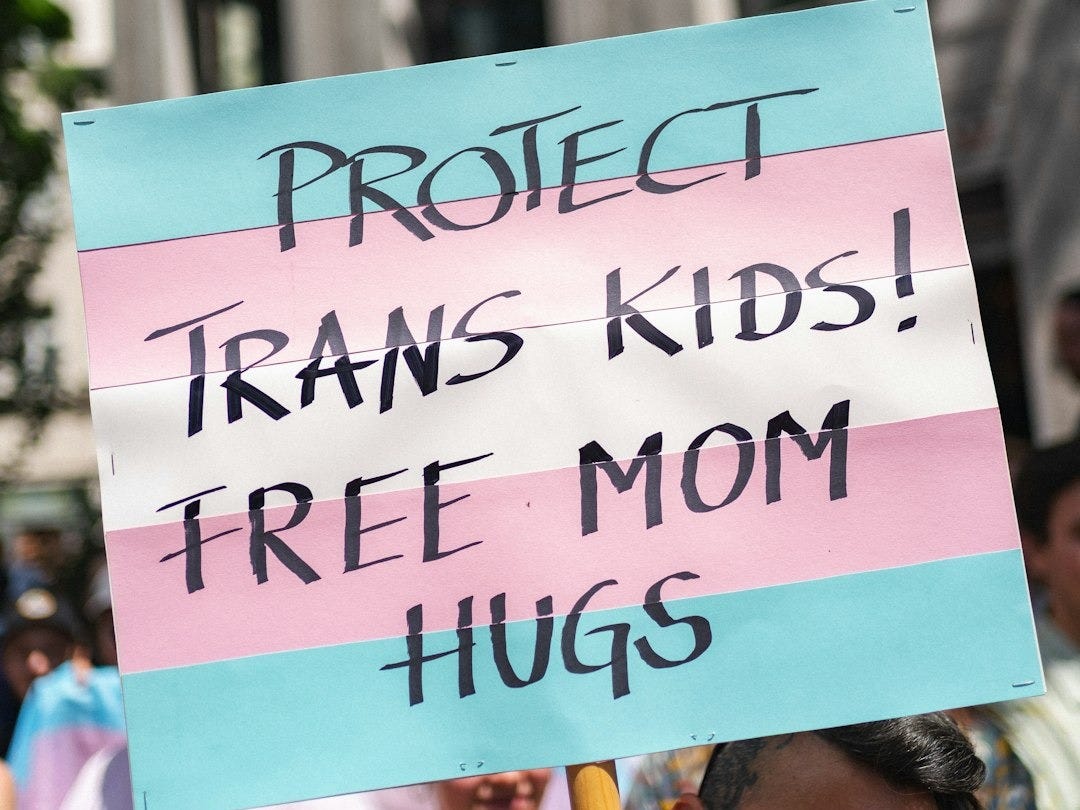
President Trump announced in a Truth Social post Tuesday that he has directed the Centers for Medicare and Medicaid Services to stop funding gender transition surgeries and hormone treatments for transgender minors. Trump wrote that the procedures amount to “barbaric surgeries and practices” that cause “unthinkable and irreversible harm” to children.
The policy, implemented through CMS Administrator Dr. Mehmet Oz, ends federal Medicaid and Children’s Health Insurance Program funding for gender-affirming surgeries and new hormone prescriptions for minors. Minors already receiving hormone treatment will keep coverage until April 2027. Mental health treatment for transgender minors remains covered under the policy. The change formalizes a rule CMS had already begun implementing before Tuesday’s announcement.
The move follows a January 2025 executive order in which Trump directed HHS to end what the order called “chemical and surgical mutilation” of children, part of a broader regulatory push targeting gender-related medical procedures for minors. Oz has been the administration’s most visible advocate for the policy. In a December Washington Post op-ed, he argued comprehensive reviews found the treatments’ benefits weak against substantial risks, and said the change could save the government more than $250 million over the next decade.
At least 27 states have already banned gender-affirming care for minors independent of this policy. Gender-affirming surgeries for minors are rare; puberty blockers and hormone treatments are far more common. The American Medical Association and most major medical organizations support access to gender-affirming care, and dispute the administration’s characterization of the evidence. The American Society of Plastic Surgeons has struck a narrower note, saying it found “insufficient evidence” that the benefits of surgical procedures specifically outweigh the risks for minors experiencing gender dysphoria, without endorsing a blanket funding cutoff.
The underlying medical evidence is itself genuinely contested, not simply a partisan talking point. The American Academy of Pediatrics has said gender-affirming care for minors is medically necessary and can “even be lifesaving,” a position echoed by the Endocrine Society, WPATH, and the American Medical Association. Research those groups cite points to reduced rates of suicidality, depression, and anxiety among transgender youth who receive care. The Endocrine Society’s own 2017 clinical guideline, using the same GRADE framework relied on by the CDC and WHO, rated the evidence supporting hormone treatment for adolescents as “low” or “very low” quality, even while recommending it. Gender-affirming surgeries for minors remain rare regardless of the policy debate; fewer than 0.1% of American adolescents received any gender-affirming care medication between 2018 and 2022.
The Endocrine Society’s guideline explains that apparent contradiction rather than leaving it unaddressed. GRADE permits a strong recommendation on low-quality evidence when withholding treatment carries its own documented risk, a recognized exception within the framework itself, not something the society improvised. The guideline treats untreated gender dysphoria as a source of significant psychological distress, and builds procedural safeguards into the recommendation rather than granting open access: a mental health provider must confirm the dysphoria is persistent rather than transient, a multidisciplinary team must assess the patient’s capacity to give informed consent to a partially irreversible treatment, and ongoing monitoring is required throughout. Those safeguards reflect a considered judgment made under uncertainty, not evidence being disregarded.
🇺🇸 What American readers need to know: This ends a specific, narrow category of Medicaid coverage, not all care for transgender minors. Mental health treatment stays covered, and coverage for minors already on hormone therapy doesn't phase out until April 2027, roughly eight months away. Major medical associations back the care and point to real mental health benefits; the strength of the evidence behind those same treatments is also genuinely disputed, including in some of those associations' own guideline documents. The Endocrine Society's own guideline addresses that tension directly, weighing the documented risk of untreated dysphoria against uncertain long-term evidence and building in safeguards rather than ignoring the gap. Both the benefit claims and the evidence concerns are real. The administration's charged language flattens that complexity rather than engaging with it.
Sources: Washington Times (US — Trump’s Truth Social statement); NPR, via WSLS (US — policy mechanics, state ban figures, ASPS finding); Fox News (US — January executive order, Oz’s Washington Post op-ed, savings projection); GLAAD (advocacy fact sheet — AAP/Endocrine Society/WPATH/AMA positions); Hastings Center Report, via Wiley Online Library (academic — Endocrine Society’s own GRADE-based evidence-quality rating); Axios (US — JAMA Pediatrics prevalence data); Endocrine Society 2017 Clinical Practice Guideline, via University of Washington (primary source — procedural safeguards, informed consent requirements); PMC, “When Strong Recommendations Rest on Weak Evidence” (academic — GRADE’s low-evidence exception, explained generally)
THE PKK PARDON
Türkiye’s parliament approved legislation Monday introducing a conditional pardon for thousands of Kurdish militants, advancing a peace process aimed at ending a four-decade insurgency. Lawmakers voted 468 to 88 in favor, with six abstentions. The measure will only take effect once Turkish authorities confirm the Kurdistan Workers’ Party, or PKK, has fully disarmed.
The 12-article legislation suspends prison sentences for some convicted PKK members and postpones ongoing investigations and trials against others for five or ten years, depending on the severity of the alleged offense. Cases will be dropped if no terror-related crime occurs within that window. Militants convicted of intentional killings, and anyone sentenced to life in prison before 2005, are excluded. That exclusion covers the PKK’s imprisoned leader, Abdullah Ocalan, and other senior figures. The bill also establishes ministerial and parliamentary committees to monitor the disarmament process. Thousands of PKK members could benefit, including fighters in exile across Europe and those currently based in Iraq and Syria. Roughly 3,500 PKK-linked detainees are expected to be released in an initial phase, about a third of all such prisoners currently held in Turkish jails.
The PKK announced last year it would dissolve, responding to a call from Ocalan himself. The group staged a symbolic disarmament ceremony in northern Iraq, where it is based, and began withdrawing fighters from Turkish territory. The PKK has waged its insurgency since 1984, initially seeking an independent Kurdish state before shifting toward demands for autonomy and expanded rights within Türkiye. The conflict has killed tens of thousands of people and spread into Iraq and Syria. Kurds make up an estimated 15 to 20 percent of Türkiye’s population. Previous peace efforts between the Turkish state and the PKK have failed, most recently in 2015.
Reaction in Türkiye’s mainly Kurdish southeast was mixed. Mehmet Kaya, head of the Diyarbakir Chamber of Trade and Industry, welcomed the bill’s passage. “It signals that violence is ending and the doors of politics are opening,” Kaya said. He added that the law alone does not resolve the broader Kurdish issue, and that further reforms are still needed. The PKK’s own response was more guarded. ANF, a PKK-linked news outlet, carried a statement from the group describing the legislation as a beginning with serious shortcomings, calling for Ocalan’s release from prison, and warning that fighters would not disarm and return to Türkiye if they remained unable to engage in democratic politics or faced prosecution for their views once back in the country.
The measure carries stakes beyond Türkiye’s borders. It could lead to closer relations between Türkiye and Iraq, and could support Syria’s government in integrating areas previously controlled by the Kurdish-led Syrian Democratic Forces, which has ties to the PKK. The bill also gives Turkish President Recep Tayyip Erdoğan an opening to court the pro-Kurdish DEM party’s political support, a potential path to remaining in office beyond his current two-term limit if parliament calls an early election.
🇺🇸 What American readers need to know: Türkiye is taking a real legislative step toward ending a conflict that has killed tens of thousands of people over four decades, one that has failed before and carries a Kurdish population’s worth of skepticism built in. It’s a story with almost no American coverage beyond wire pickups, even though it touches a US-designated terrorist organization, a NATO ally, and the future of northern Syria, a region where American forces are still active.
Sources: Associated Press, via NBC News (international wire — vote details, legislative mechanics, exile and regional stakes); Associated Press, via Washington Times (Kaya quote, ANF statement, ground reaction, demographic and historical context); Al Jazeera (Qatar, state-funded/editorially independent — abstention count, initial-phase detainee release figures)
NUMBERS AT PUBLICATION 🇮🇷 Iran: 3,636 killed 🇱🇧 Lebanon: 4,333 killed 🇮🇱 Israel: 1,200+ killed, ~5,400 wounded (includes 472 killed, 3,004 wounded in Gaza) 🇺🇸 US military: 18 killed, 687 wounded 🇵🇸 Gaza: 73,381+ Palestinians killed, 174,231 wounded 🛢️ Brent crude: $89.30/barrel ⛽ US gas: $4.04/gallon Sources: HRANA (Iran), Lebanon MOPH, INSS (Israel), DCAS (US, disputed — see Aug 4 story), OCHA (Gaza), OilPrice.com, AAA.
“Whenever the people are well informed, they can be trusted with their own government.” — Thomas Jefferson, 1789


