
The Rest of the World Report | April 23, 2026 — Morning Edition
Iran War & Beyond

Weekday morning and evening editions. Saturdays once. Good news on Sundays. All sources labeled.
WAR DAY 54 | NUMBERS AT PUBLICATION
🇮🇷 Iran: 3,636+ killed (HRANA floor estimate — 1,701 civilians including 254+ children, 1,221 military, 714 unclassified; FROZEN since Day 38/April 7; ceasefire in effect on Iran front; no updated HRANA report found this session)
🇱🇧 Lebanon: At least 2,454 killed, 7,658 wounded (Lebanese disaster management unit via Al Jazeera live blog, April 22 — full war period from March 2; Israel-Lebanon ceasefire in effect since April 16, day 8)
🇮🇱 Israel: At least 43 killed (Wikipedia citing Magen David Adom, April 19 — not confirmed via direct primary source this session, treat as indicative)
🌍 Gulf states: At least 28 killed in Iran-attributed attacks (Al Jazeera live tracker — unchanged)
🇺🇸 US military: 13 deaths confirmed (CENTCOM — unchanged)
🛢️ Brent crude: $103.90 — up from $101.73 yesterday’s close, continuing climb on Hormuz seizures and toll revenue confirmation (OilPrice.com, confirmed this session)
⛽ US gas: $4.05/gallon national average (CNN, April 19)
Sourcing note: Iran civilian casualties sourced to HRANA (US-based Human Rights Activists News Agency), which relies on a network of activists inside Iran and represents a floor estimate. Figures frozen since Day 38/April 7; no updated report found this session. Lebanon figure sourced to Lebanese disaster management unit via Al Jazeera live blog April 22. Israel figure sourced to Wikipedia citing Magen David Adom as of April 19 — not confirmed via direct primary source this session. Methodology differs between sources; figures should not be treated as directly comparable.
1. ISRAEL HAS KILLED MORE JOURNALISTS THAN ANY COUNTRY IN RECORDED HISTORY. AMAL KHALIL WAS THE LATEST.
On Wednesday afternoon, Amal Khalil, 43, a reporter for Lebanon’s Al-Akhbar newspaper, was covering the Israel-Hezbollah war in the village of At-Tiri in southern Lebanon when an Israeli strike hit a vehicle near her position, killing two other people. She and freelance photojournalist Zeinab Faraj took cover in a nearby house. Israeli forces then struck that house too.
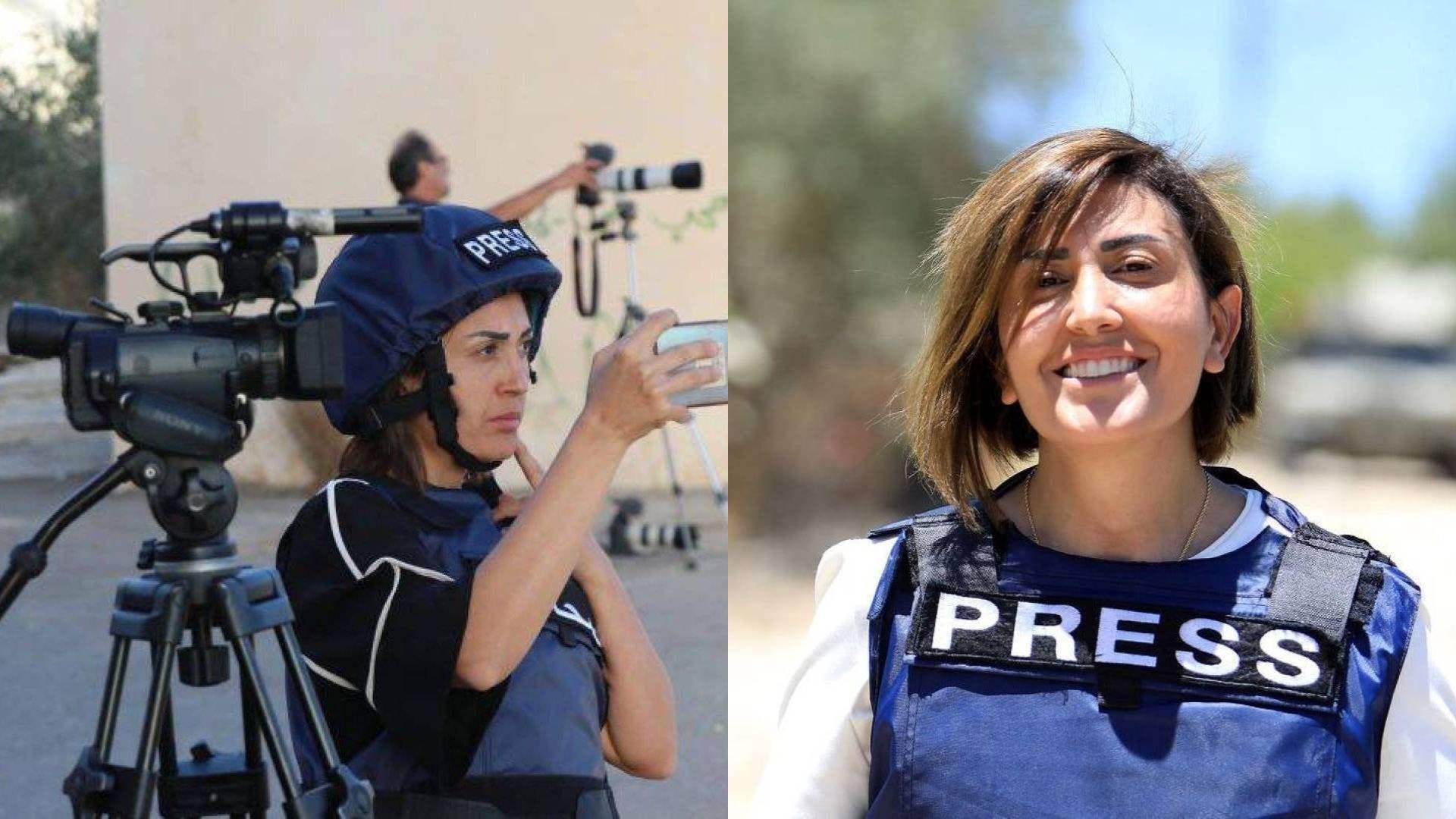
When Lebanese Red Cross paramedics arrived to evacuate the wounded, they were stopped. The Lebanese Health Ministry confirmed Israeli forces fired a sound grenade and live rounds near the ambulance. Rescue workers were unable to reach Khalil. She remained trapped under the rubble for hours. Civil defence workers eventually recovered her body. Faraj was evacuated with a head injury. Lebanese Prime Minister Nawaf Salam called it a war crime.
What happened next is not new. The Committee to Protect Journalists had documented a direct, named death threat against Amal Khalil from the IDF in September 2024 — nineteen months before she died under rubble that paramedics were blocked from reaching. The head of Lebanon’s Union of Journalists accused Israel of deliberate targeting. The IDF said it had struck vehicles it believed came from a Hezbollah military structure and denied blocking rescue workers.
Khalil’s killing is not an isolated incident. It is the latest entry in a documented sequence. Since the Iran war began on February 28, Israeli strikes have killed at least nine journalists in Lebanon and Gaza:
March 18: Mohammed Sherri, Al-Manar TV, central Beirut
March 25: Hussain Hamood, Al-Manar TV freelance, Nabatieh — killed while filming Israeli strikes
March 28: Three journalists killed in a single strike on a clearly marked press car on the Jezzine highway — Ali Shoaib (Al-Manar), Fatima Ftouni (Al-Mayadeen), and her brother Mohammed Ftouni (freelance photographer)
April 8: Three more in a single day — Mohammed Washah (Al Jazeera Mubasher, Gaza), Ghada Dayekh (Sawt Al-Farah, Lebanon), and Suzan Khalil (Al-Manar/Al-Nour Radio, Lebanon)
April 22: Amal Khalil, Al-Akhbar, At-Tiri
Several of these journalists worked for Al-Manar, Al-Mayadeen, and Al-Akhbar — outlets that are Hezbollah-affiliated or editorially aligned with Hezbollah. That is the IDF’s consistent justification: these journalists were associated with the enemy and some were alleged combatants. Israel accused Shoaib, without providing evidence, of being a member of Hezbollah’s Radwan Force. UN human rights experts reviewed that claim and noted the IDF’s evidence was a photoshopped image. Their statement was direct: working for a media outlet affiliated with an armed group does not constitute direct participation in hostilities under international humanitarian law. Journalists are civilians. They remain so regardless of who employs them.
The broader record is not ambiguous. The CPJ’s February 2026 report found Israel killed 86 of 129 journalists killed worldwide in 2025 — two thirds of all global press deaths, for the third consecutive year. Al Jazeera reported this week that Israel has now killed more journalists than any other country in CPJ’s recorded history. The UN human rights experts, after the March 28 killings, called for an international independent investigation, describing the pattern as reflecting Israel’s being “emboldened by impunity for previous killings of journalists in Lebanon, Gaza and the West Bank.”
None of that investigation has happened.
🌍 TRANSLATOR’S NOTE: The Khalil killing has led international media coverage from Beirut to London this morning. CPJ, The National (UAE), and WAFA all confirmed and reported it overnight. The specific details — the double strike on journalists who had taken shelter, the blocked rescue, the prior named death threat — have generated the kind of international reaction that the deaths of individual correspondents rarely produce. The Lebanese Information Minister called it “a criminal act and a flagrant violation of international humanitarian law.” What is notable in the international press is not just the outrage, but the exhaustion: this is not the first statement of this kind, and the bodies keep accumulating.
🇺🇸 What American readers need to know: Today, Israeli and Lebanese ambassadors will sit down at the State Department for a second round of direct talks aimed at extending a ceasefire. The ceasefire that was supposed to protect southern Lebanon did not protect Amal Khalil. She was killed under it, in a house she ran to for safety, while rescue workers were held back by gunfire. The talks today are about extending that ceasefire by a month. Whether Khalil’s death — and the deaths of at least eight other journalists before her — is raised at that table is unknown. What is known is this: the country that has killed more journalists than any other in recorded history sits across that table as a negotiating partner.
Sources: Washington Post (US confirmation — Khalil killed in strike on shelter, confirmed this session); WAFA (Palestinian news agency — Lebanese Health Ministry statement, blocked rescue confirmed, confirmed this session); CPJ (Committee to Protect Journalists — prior death threat documented, CPJ regional director statement, confirmed this session); CNN (US confirmation — fourth media worker killed since March, CPJ global two-thirds figure, UN investigation call, confirmed this session); The National (UAE, editorially independent — Khalil age confirmed 43, double-strike sequence, Al-Akhbar confirmation, confirmed this session); CPJ (March 28 triple killing — press car strike confirmed, IDF statement, CPJ director quote, confirmed this session); TIME (US — full journalist death sequence confirmed, CPJ 86-of-129 figure confirmed, confirmed this session); OHCHR (UN — photoshopped evidence finding, international law on affiliation, independent investigation call, confirmed this session); Al Jazeera (Qatar, state-funded/editorially independent — more journalists killed than any country in CPJ history, confirmed this session)
2. IRAN COLLECTED ITS FIRST HORMUZ TOLL PAYMENT THIS MORNING
This morning, Iran’s deputy parliament speaker Hamidreza Hajibabaei announced via state media that the first revenue from Strait of Hormuz transit tolls had been deposited into Iran’s Central Bank account. The toll system has been operating since mid-March, codified in the Strait of Hormuz Management Plan passed by Iran’s parliament on March 30-31. Ships are charged up to $2 million per vessel to transit the waterway. Payment is accepted in Bitcoin, USDT, or Chinese yuan routed through Kunlun Bank — all three methods designed specifically to operate outside the US dollar system and beyond the reach of American sanctions.
The significance of the first central bank deposit is not the sum. It is the architecture. Iran is not merely disrupting the world’s most important energy chokepoint. It is transforming it into a sovereign revenue mechanism, extracting payment from the global economy while under US blockade, using cryptocurrency to do it. The toll system exists precisely because the US cannot easily intercept it: peer-to-peer crypto transactions settle without touching the US correspondent banking system, making real-time enforcement technically difficult even for OFAC.
Bloomberg reported Wednesday that shipping executives at two of the world’s largest commodity traders warned the tolls set “a dangerous precedent for the free flow of global trade.” Iran International published an analysis questioning the scale of revenue projections — estimates of $600-800 million per month assume traffic volumes the disruption itself has suppressed. But the precedent is real regardless of the revenue. Iran is the first state to formally codify transit fees on a natural international strait and to collect them in cryptocurrency. International maritime law — specifically the transit passage regime established by the UN Convention on the Law of the Sea — prohibits charging vessels simply for passage through international straits. Iran has not ratified the convention. It does not consider the prohibition binding.
Brent crude reached $103.90 this morning, building on yesterday’s $101.73 close driven by the ship seizures.
🌍 TRANSLATOR’S NOTE: Bloomberg and Iran International both covered the toll story this week, framing it as a structural shift rather than a tactical disruption. The international business press is asking a question American media has not fully engaged with: what happens to the principle of free passage through international straits if Iran establishes, normalises, and profits from the precedent? The Suez Canal charges fees because it is an engineered passage requiring maintenance. The Strait of Hormuz is a natural waterway. If Iran’s toll system survives the war, it rewrites the rules of international maritime commerce.
🇺🇸 What American readers need to know: Iran is collecting rent on the world’s oil supply, in Bitcoin, while under US naval blockade. The first payment hit its central bank this morning. The blockade that Trump extended is not stopping the toll system — the toll system was built to survive the blockade. Every ship that pays rather than rerouting around the Cape of Good Hope is, in effect, funding the Iranian state. The question Washington has not yet answered publicly is how it plans to respond to a sanctions evasion mechanism that operates peer-to-peer, at scale, in international waters.
Sources: Times of Israel live blog (Israel, right-centre — deputy parliament speaker Hajibabaei statement, first toll revenue confirmed, confirmed this session); Bloomberg (markets and business — commodity trader warnings, dangerous precedent framing, confirmed this session); Iran International (opposition-aligned, Saudi-connected — flag; toll system mechanics, revenue analysis, confirmed this session); TRM Labs (fintech specialist — cryptocurrency payment mechanism, OFAC enforcement gap, confirmed this session); 2026 Hormuz crisis Wikipedia (secondary — Hormuz Management Plan codification March 30-31, UNCLOS context, confirmed this session)
3. LEBANON-ISRAEL ROUND 2 OPENS TODAY. THE CEASEFIRE IT IS TRYING TO EXTEND HAS ALREADY FRAYED.
At the State Department in Washington today, Israeli and Lebanese ambassadors will reconvene for the second round of direct talks. The US objective is straightforward: extend the 10-day ceasefire that took effect April 16 — which expires Sunday — and keep the Lebanon track alive while the Iran-US diplomatic process stalls. Lebanon is expected to request a one-month extension. Israel’s stated objective is Hezbollah’s disarmament. Secretary of State Rubio will facilitate, alongside US Ambassador to Lebanon Michel Issa.
The ceasefire those talks are meant to extend has been fraying since it began. On Tuesday, Hezbollah fired rockets and drones at Israeli forces for the first time since the truce took effect. The IDF has continued operations in southern Lebanon under the ceasefire’s provision allowing strikes against what Israel designates “imminent threats.” Israeli ground forces remain deployed inside Lebanese territory. Israel has continued demolishing structures along the border it describes as a defensive perimeter. On Wednesday — the eve of these talks — Israel killed Amal Khalil in a strike on At-Tiri, the deadliest day in southern Lebanon since the ceasefire was announced.
Hezbollah has not changed its position. Secretary-General Naim Qassem has called the talks “free concessions.” His organisation boycotted the first round and is boycotting this one. The Lebanese government is negotiating against the explicit instruction of the most powerful military force operating on its territory — a test of state authority that has no clean precedent in Lebanon’s recent history.
The talks are not without structural significance. They are happening at all. The first round, April 14, was the first direct Israeli-Lebanese diplomatic contact since 1993. The fact of a second round, even against this backdrop, indicates both governments see some value in the process continuing. A senior US State Department official said this week: “The time has come to treat Lebanon as a sovereign state.” Whether that treatment extends to accountability for what happened to Amal Khalil is a question today’s delegations will not answer publicly.
🇺🇸 What American readers need to know: The talks today are about extending a ceasefire that has already seen continued Israeli strikes, Hezbollah rocket fire, and the killing of a journalist in her shelter. The Lebanese government is negotiating without Hezbollah’s consent and against its instruction. Israel’s delegation arrives the morning after an incident its own military says it is reviewing. The gap between what these talks represent — the first sustained direct Israeli-Lebanese diplomacy in a generation — and what is actually happening on the ground in southern Lebanon is the story of this ceasefire.
Sources: The National (UAE, editorially independent — Thursday talks confirmed, ceasefire expires Sunday, one-month extension request, State Dept quote, confirmed this session); ABC News (US confirmation — Hezbollah rejection, ceasefire fraying, Israeli position on disarmament, confirmed this session); Times of Israel live blog (Israel, right-centre — IDF drone intercept this morning, confirmed this session)
“Whenever the people are well informed, they can be trusted with their own government.” — Thomas Jefferson, 1789
Thank you, Rudy. It's hard to read these- I can't imagine how hard these are to compile day after day. 🙏🏽 There is a special place in heaven for you. Thank you for exposing the targeting of journalists, especially. The pen is certainly mightier than the sword and all governments know it.